
The Travel of Images
Jan Robert Leegte’s compression works and the condition of the travelling image.

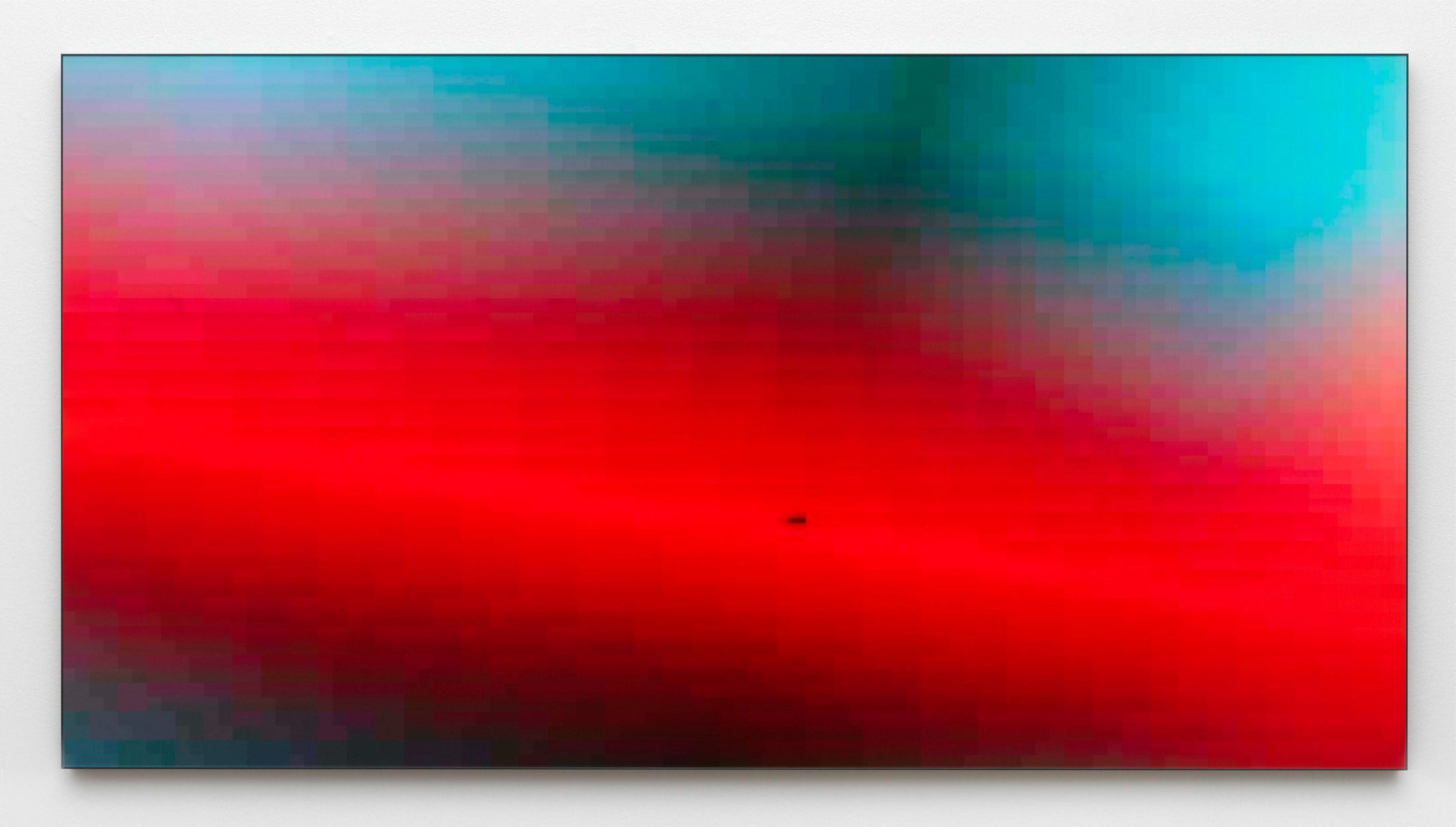
An image never travels whole. Before it reaches us, it has already been reduced, translated, damaged, reassembled. It has passed through systems that decide what can disappear without being missed. Compression is not an afterthought of the digital image. It is one of its conditions.
Jan Robert Leegte’s compression works begin exactly there: not with the image as motif, but with the operation that allows an image to arrive.
I have just come back from Basel. Art Basel closed on Sunday, and over the past days Office Impart (Berlin) and Upstream Gallery (Amsterdam) showed Leegte in a joint solo presentation at Zero 10, the fair’s curated section for art of the digital era. Three bodies of work were brought together, each circling the same subject from a different angle: compression, material transfer, and the strange mobility of images.
Leegte is not a late arrival to the digital. He belongs to a generation of artists who understood early that the browser, the file format and the interface are not neutral tools of distribution. They are material. They shape what can be seen, how it appears, and what kind of body an image can have.
That is what makes this presentation matter. It does not simply show digital images in physical space. It shows that the digital image was never immaterial in the first place.
The image as operation
Compression is the thing we are trained to avoid. The digital age kept promising more resolution, more sharpness, more fidelity. But online, that resolution never reached us untouched. A photograph at full size is too heavy to move, so almost every image that travels the internet is first made small enough for the journey. The image survives by losing itself.
In Leegte’s work, that loss is not the opposite of image quality. Loss is the condition under which the image becomes mobile.
What he puts on the wall is not a photograph. His material is the mechanism itself: one of the basic building blocks of the internet, the compression that sits beneath every image online and is meant to remain invisible while it does its work. He uses no photograph, no graphic, no pre-existing motif. Through an algorithm he generates simple colour fields that make that hidden operation appear.
But he also leads the algorithm into territory it was never designed for. A photographic codec is built to handle complex photographic information; Leegte feeds it simple colour fields, a situation almost too pure for the system. The result is a misfiring that is not really a failure. The algorithm begins to produce artefacts. It does not merely reduce complexity. It generates it.
That is the moment Leegte holds on to: the state in which the image is no longer only a file, not yet only an object, but an operation becoming visible.
What keeps drawing me back to these works is that they refuse to choose a single condition. They are image and mechanism, loss and production, screen and wall. That unresolved state is the territory I keep calling superposition.
The JPEG becomes an object
The compression thread runs through Leegte’s practice, and it has always been about travel. Scan (1997), a JPEG blown up and slowly scrolling, is the first predecessor of the series, an early attempt to show the beauty of JPEG compression. Compressed Landscapes (2016) followed and was later shown at the Van Gogh Museum. Then, in 2022, came the on-chain collection JPEG on Art Blocks: 275 tokens, each one rendering a real JPEG live from its hash.
That collection is still one of the clearest works I know about the condition of the digital image. Resize the browser window and the image recompresses in front of you. You can literally drag the JPEG out of the page. The work is caught in the act of moving.
Leegte prefaced the collection with Rothko: “A painting is not a picture of an experience, but is the experience.” His own conclusion followed: “This is not a JPEG depicting an image. The JPEG is the image itself.” He has offered, half-jokingly, a name for the territory: compressionism.
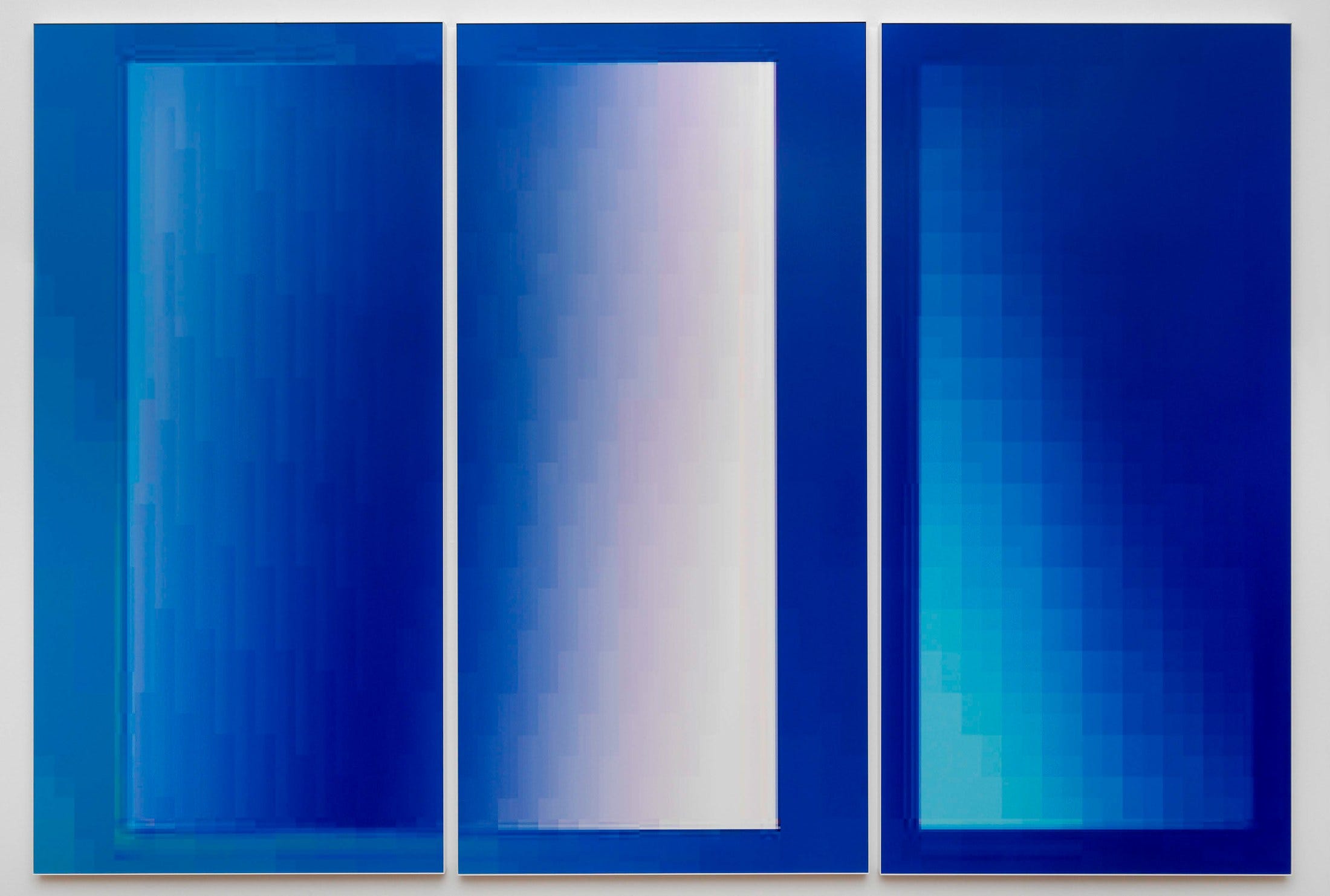
From there the series stepped off the screen and onto the wall. First in Amsterdam (Upstream Focus: JPEG, early 2024), then in Berlin, where Office Impart showed Selection and the project arrived as physical, one-of-a-kind editions: the live-rendered token fixed onto a single aluminium surface. That move holds the whole paradox in one object. You cannot carry anything purely physical into the digital, nor fully translate the digital back into the physical; there are only interfaces, and a JPEG pressed onto aluminium is one of them. That is where one of these works entered my life. My closest friend and I bought a JPEG together; it belongs to both of us and to neither of us alone, which turns out to be the right ownership structure for a work about a state that refuses to settle.
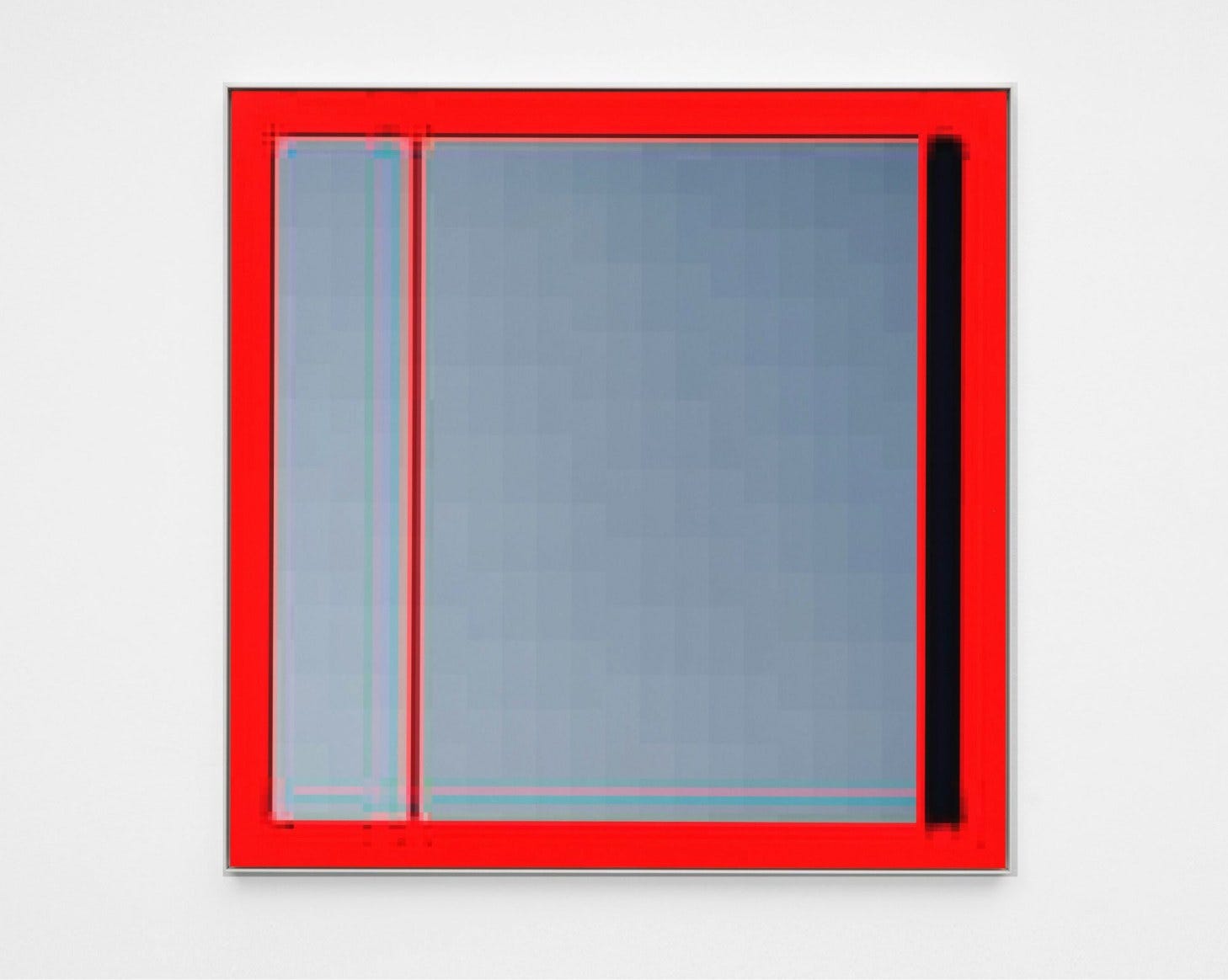
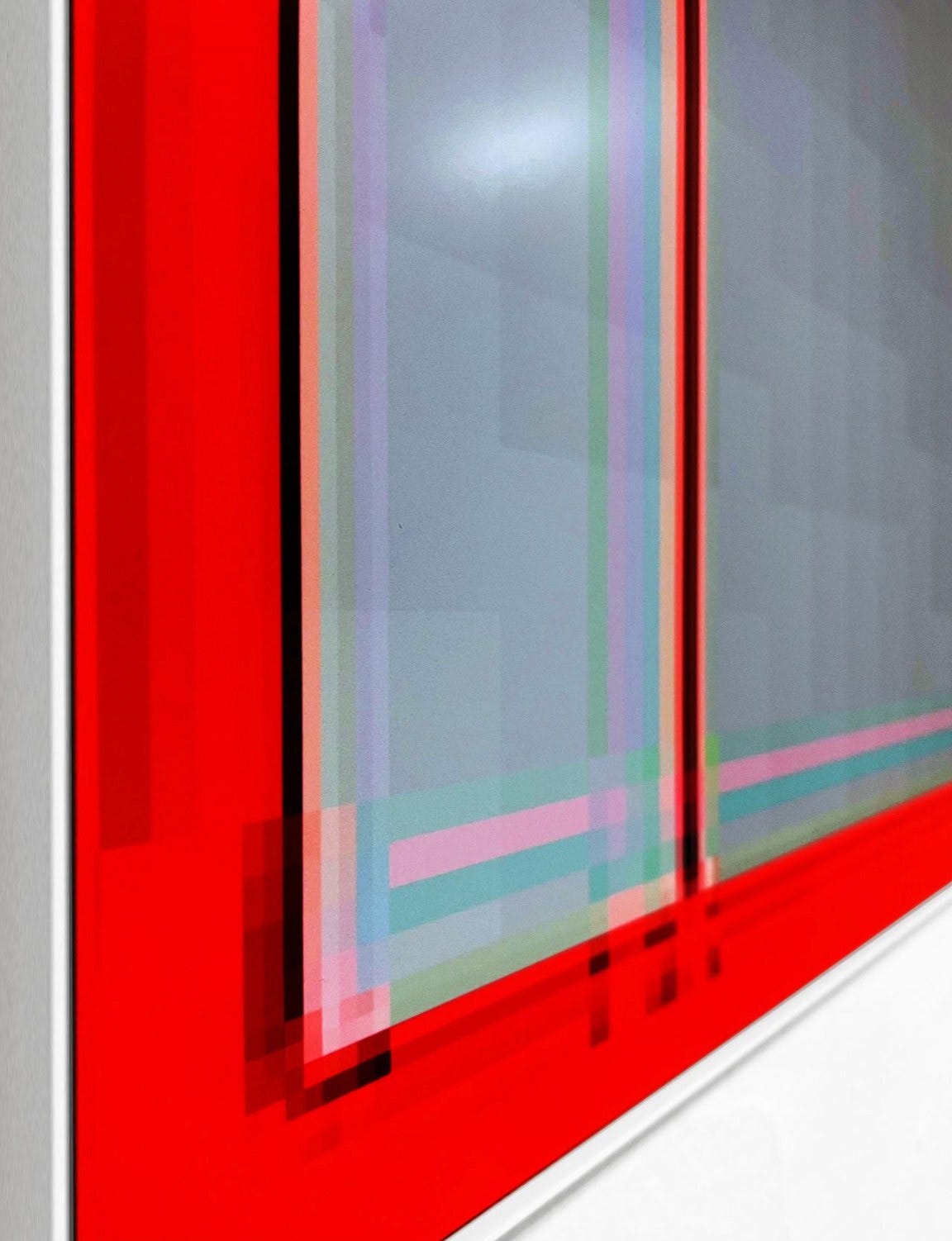
When we bought it, Leegte told us something I keep coming back to. These physical pieces have no digital twin. They are not prints of the tokens from the first drop; he made them as one-of-a-kind objects and has no intention of minting the matching file. A digital master does exist, but only in his hands, kept in case the work ever has to be restored or reprinted. It is not a counterpart, more a negative in a drawer: it exists so the work can survive, not so it can circulate.
The curator Sanneke Huisman wrote that Leegte “quietly monumentalises” digital elements. Having lived with one for a while now, I would say that is exactly what it does.
Compression, extended
If the JPEG works carry the digital into a physical body, the newest series does the reverse, dissolving the body back into time. Orbits extends compression into duration: a 3D scene of orbiting spheres in which a WebGL engine generates a fresh sequence of JPEGs twelve frames a second, with no source file and no recorded footage behind it. The world exists only in the instant the codec produces it. Leegte told me at the booth that the idea connects to the renewed push outward into space, the crewed flyby that just looped around the Moon, the talk of a first journey to Mars. It is a fitting place for the thread to arrive, because an image from out there is the same problem at its limit: the farther a picture has to travel, the more of it must be thrown away to survive the trip, and what reaches us is only ever the compressed signal, with no master waiting on the other side. It is the same operation, carried across the solar system instead of across a browser. Orbits is that condition made into art: an image that exists only while it is travelling.
Next to it, Sightings runs the operation the other way around. A generative system produces images that look photographic without any photograph underneath: no scene, no camera, and yet the results read as glimpsed, telephoto shimmer, satellite stills, footage just slightly too compressed to be sure of. “It is not a photograph of something blurry,” Leegte says. “It is the blurriness itself, given the shape of a photograph.” At a moment when AI-generated images have made the provenance of every picture an open question, that is a quiet and exact intervention: no training set, no source, and something arrives anyway.
The condition
It matters where all of this was hanging. Zero 10, in its first Basel edition, was curated by Trevor Paglen and Eli Scheinman under the theme “The Condition,” arguing bluntly that most of the art of the last twenty years has been digital whether we noticed it or not, with a historical spine that runs back to pioneers like Vera Molnár. Leegte sits near the centre of that argument rather than at its edge.
An image is not supposed to survive the distance it is asked to cross. It loses most of itself on the way, and arrives anyway. That is what each of these works is: not a picture, but the proof of a crossing. What appears, at the end of every one of these journeys, is something that should not really be here. That is exactly what art is.
A note: parts of this text first appeared, in an earlier form, in a post I published on LinkedIn in October 2024.